

When it comes to getting the absolute maximum performance from your car on track, very few setup changes make as much difference as camber and toe. These two alignment settings directly affect tyre contact, grip levels, stability and overall driver confidence. Get them right and the car feels planted, predictable and fast. Get them wrong and you can destroy tyres in a single session, fight understeer all day, or end up with a car that feels nervous at speed.
As a specialist in motorsport alignment and aftermarket suspension upgrades, this is something we regularly deal with at trackdays, in the workshop, and with customers ordering parts through shop.suspensionsecrets.co.uk.
In this guide, we’ll break down how camber and toe actually work. We’ll also explain how we set them properly, and why a tailored suspension setup is essential if you want the best from your car.

Why Camber and Toe Are Critical for Track Car Alignment and Handling Performance
Camber is the angle the wheel sits at relative to vertical, while toe describes whether the wheels point slightly inwards or outwards when viewed from above. These two settings control how the tyre contacts the tarmac under load, especially when cornering, braking and accelerating.
On track, the car rolls onto the outside tyres through the corner. If the alignment isn’t correct, the tyre will only use part of its contact patch, which means less grip, more heat and faster wear. This is why factory alignment settings often aren’t suitable for track use. They’re designed for road comfort, tyre longevity and safety, not maximum cornering performance.
When we set up cars at trackdays, we always start by putting the car on a perfectly level surface. In the workshop we use a motorsport-grade flat patch, laser levelled to ensure each wheel sits on exactly the same plane. From there we can measure camber precisely using a calibrated digital camber gauge, referencing the wheel rim to get an accurate reading in degrees before making any adjustments.

How to Adjust Camber on Performance and Track Cars (Camber Plates, Arms and Other Upgrades)
Different suspension designs allow for different adjustment methods. On most modern performance cars with a MacPherson strut front suspension, camber adjustment is usually done at the top mount. Suspension Secrets camber plates – available through shop.suspensionsecrets.co.uk – allow much greater adjustment than the factory setup. This is essential for serious track use.
At the rear, camber is often adjusted using eccentric bolts or adjustable control arms. Performance toe arms and camber arms give far more range and precision than OEM parts. This is why we normally recommend upgrading these when running aggressive track alignment. Without the right hardware, you simply cannot reach the camber settings needed to make the tyres work properly.
Upgrades such as adjustable toe arms, camber plates, uprated springs and performance dampers allow the alignment to stay consistent under load. This is just as important as achieving the numbers in the first place.
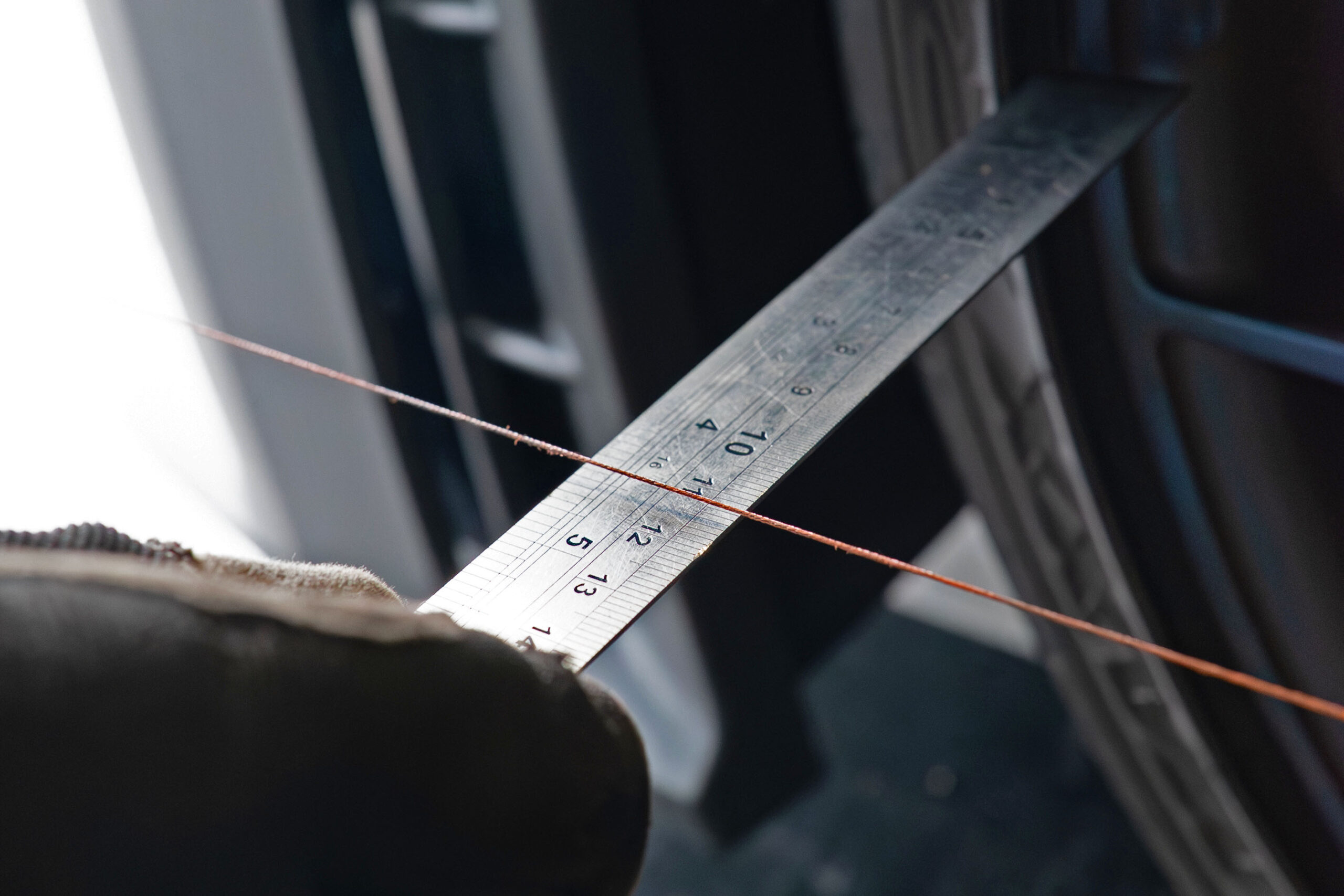
String vs Laser Wheel Alignment – How Motorsport Alignment Is Done for Track Cars
For toe settings, we often use a motorsport string alignment kit rather than relying purely on a laser alignment machine. Although laser systems are very precise, a string system can actually be more accurate when it’s set up correctly. This is because it has to be calibrated to the car every single time.
With a string rig, we measure from the chassis centreline and confirm the strings are perfectly parallel to the car before taking readings from the wheel rims. By measuring the distance from the string to the front and rear of each rim, we can calculate exactly how much toe the wheel has. This method works both in the workshop and at track days, which makes it ideal when we’re setting up customer cars on location.
It’s also one of the reasons we can support customers who buy suspension parts from Suspension Secrets because we know the alignment method will be accurate wherever the car is being set up.

Why There Is No Single Perfect Camber and Toe Setup for Every Track Car
One of the most common questions we get is what the best camber and toe settings are. The truth is there isn’t a single answer because the ideal alignment depends on the exact specification of the car and how it is used.
The correct setup can change depending on:
- Drivetrain layout (FWD, RWD or AWD)
- Engine position (front, mid or rear engine)
- Tyre type and compound
- Suspension modifications and geometry changes
- Power level and weight distribution
- Driver preference and driving style
- Whether the car is used on road, track, or both
Due to this situation, we never give generic numbers without knowing the full specification of the car. When customers order upgrades from Suspension Secrets, we provide a free suspension setup sheet where we ask about tyres, usage, and modifications before recommending settings. A setup that works perfectly on one car can feel sub-optimal on another, even if the models are identical.

Factory Alignment vs Track Alignment Settings – Why OEM Setup Doesn’t Work on Track
A good example is the Cayman GT4. In factory form, the car runs relatively mild camber and a small amount of toe-in on both axles. These settings are designed for road use, not track performance. As we found with our own GT4 – when the car is driven hard the outer edges of the tyres overheat very quickly and the car tends to understeer at the limit.
Once the Cayman GT4 is fitted with Suspension Secrets camber plates, adjustable arms and uprated springs, the alignment can be made far more aggressive. With more negative camber at the front and rear, combined with the correct toe settings, the car becomes far more stable in high-speed corners while also turning in much more sharply.
However, those numbers only work because the car has the right tyres, the right suspension parts, and the right use case. Copying settings without matching the hardware rarely gives the same result, which is why a proper setup always goes hand in hand with the correct aftermarket upgrades.

Track Alignment vs Road Alignment – How Suspension Setup Changes for Dual-Use Cars
A full track alignment is not always suitable for road driving. Track setups normally use much more negative camber and more aggressive toe angles because the car is being optimised for maximum grip during heavy braking and cornering.
For cars that are still used on the road, the settings usually need to be dialled back slightly. Too much camber can cause uneven tyre wear in normal driving, while aggressive toe settings can make the car feel nervous at motorway speeds or in wet conditions. The key is deciding how the car is used most of the time and building the alignment around that.
If the car is trailered to track, we can focus entirely on performance. If it’s a dual-purpose car, the setup needs to balance grip with stability and tyre life.

How to Tell If Your Camber Settings Are Correct on Track (Tyre Wear & Handling Signs)
The tyres will always tell you whether your camber settings are working. After a proper session on track, inspect the tyre across the full width of the tread and look for these signs.
Correct settings:
- Even wear across the tread
- Light scrub marks reaching close to the outer edge
- No excessive wear on the inner shoulder
- No overheating on one side of the tyre
More negative camber required:
- Outer edge wearing faster than the rest of the tyre
- Understeer mid-corner
- Outer shoulder overheating or going greasy
Too much negative camber:
- Inner edge wearing faster than the outer
- Outer edge not being used properly
- Reduced stability under braking
It’s also important to check tyre pressures at the same time. If the centre of the tread wears faster than both edges, the tyre is usually over-inflated. If both edges wear faster than the centre, the pressure may be too low. Alignment and pressure always need to be considered together, especially when running track tyres.

How to Use Tyre Temperatures to Fine-Tune Camber and Track Alignment Settings
For more accurate setup work, we often use a tyre temperature probe. By measuring the temperature across the inner, centre and outer parts of the tread immediately after coming off track, you can see exactly how the tyre is working.
Ideally, the inner edge should be slightly hotter than the outer edge, with the centre somewhere in between. That tells us the camber and pressure are working correctly under load. If the outer edge is hotter, more negative camber is usually needed. If the inner edge is much hotter, the camber may be too aggressive.
This kind of fine tuning is exactly what we do after fitting Suspension Secrets upgrades because the extra adjustment range allows the tyre to be used properly across its full width.

How Toe Settings Affect Handling, Stability and Corner Exit Grip on Track
Toe settings have a huge effect on how the car feels. More rear toe-in generally improves stability and traction on corner exit, while a small amount of front toe-out can make the steering more responsive. However, too much toe-out can make the car feel nervous at high speed. And too much toe-in can make the front end feel slow to react.
Because of this, toe is normally adjusted after camber has been set. The final numbers are chosen based on how the car actually feels on track rather than just aiming for a specific figure.

Final Thoughts on Camber, Toe and Track Alignment Setup
Camber and toe are two of the most powerful tools you have when setting up a car for track use. When they’re correct, the car feels sharper, faster and far more predictable. When they’re wrong, performance suffers no matter how good the tyres or suspension might be.
There is no universal setup, which is why every car should be aligned based on its tyres, modifications and intended use. The best results always come from combining the right suspension upgrades with a proper motorsport alignment.
Track Setups – FAQs
What camber settings should I run for track use?
There is no single camber setting that works for every car. The correct camber depends on tyre type, suspension setup, drivetrain layout, and whether the car is used only on track or also on the road. Track cars usually run more negative camber than factory settings to improve grip in corners, but the exact numbers should always be tailored to the vehicle.
What does toe adjustment do on a track car?
Toe affects how the car responds to steering input and how stable it feels at speed. Rear toe-in usually improves stability and traction on corner exit, while front toe-out can make the steering sharper. Too much toe in either direction can make the car unstable or cause excessive tyre wear, so it should always be set as part of a proper alignment.
Why don’t factory alignment settings work on track?
Factory alignment settings are designed for road comfort, tyre life and safety, not maximum grip. On track, the car experiences much higher cornering loads. This means the tyres need more negative camber and different toe settings to maintain full contact with the tarmac. Without this, the outer edges of the tyres can overheat and wear quickly.
How can I tell if my camber is correct?
You can usually tell by looking at tyre wear after a track session. Even wear across the tread means the camber is close to correct, while heavy wear on the outer edge usually means you need more negative camber. Uneven inner wear can mean there is too much camber. Tyre temperatures and pressures should also be checked to confirm the setup.
Do I need suspension upgrades to get the right alignment?
In many cases, yes. Factory suspension often does not allow enough adjustment for proper track alignment. Upgrades such as camber plates, adjustable arms and performance dampers allow more precise setup and help the alignment stay consistent under load. This is why proper suspension upgrades and alignment should always be done together for the best results.


